If you are looking for the best SIP plans for 1000 per month, you must know some hidden facts that may help you to choose the best SIP Plan before starting. There are many things to look for the best SIP plan that most APPs or platforms do not tell you.
After working with investors as an AMFI-registered Mutual Fund Distributor (MFD), I can tell you something very clearly that today is best and tomorrow is not the same.
From my personal experience with mutual fund investors, I can say you must look at the basic key point before starting to SIP (Systematic Investment Plan) . Each point i have explain one by one below-:
Table of Contents
The Truth About Starting with ₹1000 Per month
The best part is that you are starting to save ₹1000 per month, that’s the first step to enter in investing. If you keep investing for a long term like 20 to 30 years, you will definitely accumulate handsome money.
Let’s do a simple calculation of ₹1000 per month using SIP calculator.
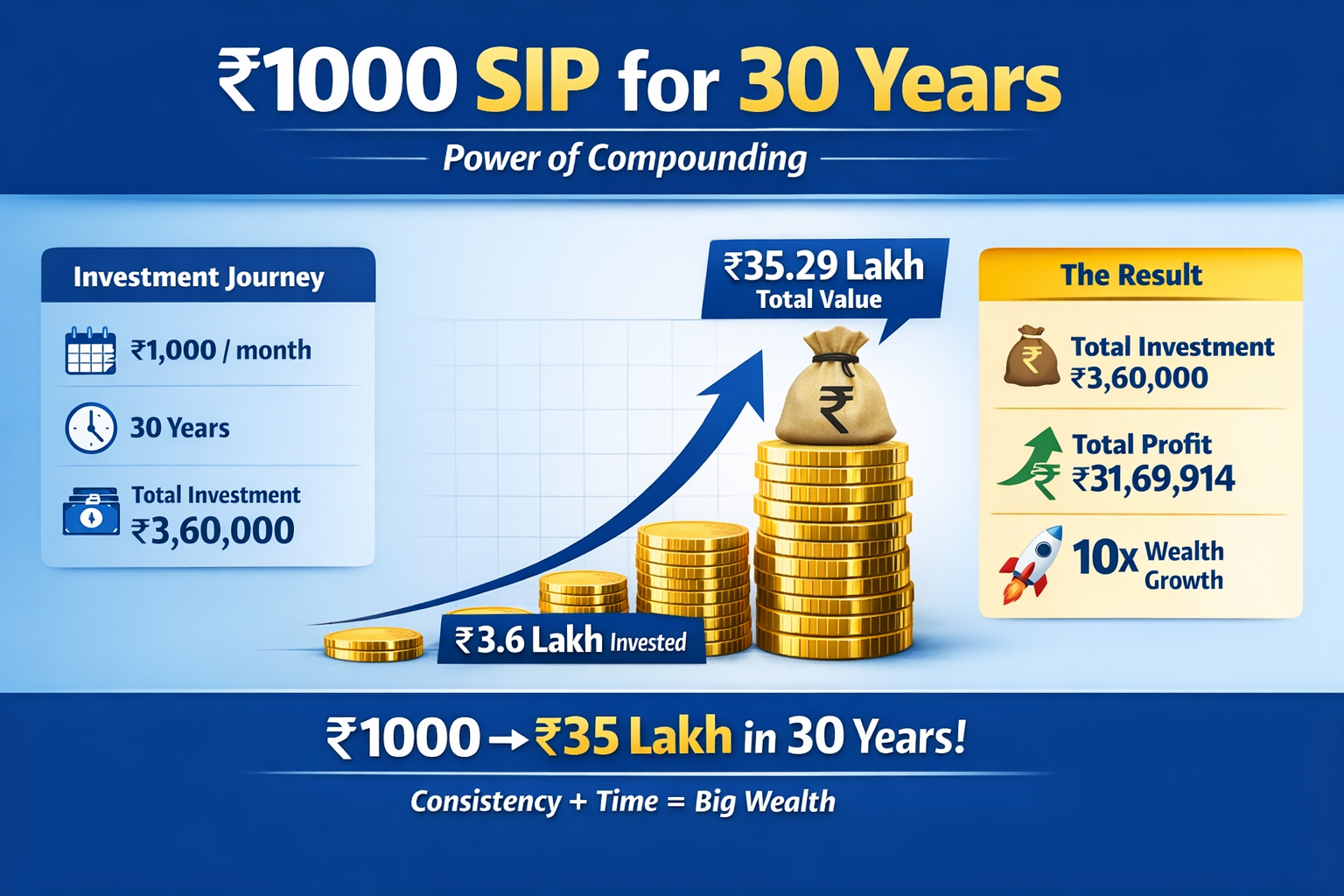
Suppose you invest for 30 years and expect 12% return annually. By using this data we get surprising results.
Total Investment: ₹ 360000.00
Total Amount: ₹ 3529913.77
Total Profit: ₹ 3169913.77
Your total investment of 3,60,000 becomes 35,29,913.77 in 30 years. It get 10 times return, that is a decent return. But it is just an estimation of return.
Such a return looks good but there are other factors also that may reduce the return.
Like “Expense Ratio” can eat your profit over time.
Also read : If I Invest ₹ 2000 SIP for 20 Years, How Much Can I Really Make?
Expense Ratio
Expense Ratio is annually charge that is taken by AMCs. Normally charges can be up to 3%. It looks like small amount but over the time, this expense ratio can change the result.
If you want to reduce the Expense Ratio, you can choose Direct mutual fund instead of Regular mutual fund. Direct mutual funds are lower in expense ratio.
| Plan | Cost | Impact |
| Direct | Low | Higher returns |
| Regular | High | Lower returns |
Even choosing a Direct mutual fund option may not guarantee return, you should also choose see riskometer.
RiskoMeter
Riskometer tells you which fund is more risky or less risky. So before starting with the best SIP, you must look for a riskometer and choose the fund accordingly.
| Level | Risk |
| Low | Stable |
| Moderate | Balanced |
| High | Volatile |
| Very High | Aggressive |
IDCW vs Growth
IDCW (Income Distribution cum Capital Withdrawal) is an option where you can get a dividend as income while investing in SIP or mutual fund.
But in the Growth option you choose to reinvest dividend while investing.
If you choose, IDCW option then you have to pay tax on every payout but in the Growth option, tax is applied when you sell a mutual fund.
We have written a detailed article on IDCW Option and TAX you can check.
| Feature | IDCW | Growth |
| Payout | Yes | No |
| Tax | Every payout | On selling |
| Compounding | Stops | Continues |
Exit Load
Exit load is the charge when you redeem SIP or mutual fund before time according to terms & conditions of mutual fund schemes.
So before starting SIP must look for exit load also. But if you are planning for the long term then you don’t have to think about exit load.
| Time | Charge |
| < 1 year | ~1% |
| > 1 year | 0% |
Fund Size (AUM)
Every mutual fund has a fund size. Look for those funds which have large fund sizes. Large fund sizes give the idea about stable risks.
| Size | Impact |
| Small | Risky |
| Large | Stable |
Inflation Impact (Very Important)
Inflation is most important to consider for the long term as inflation reduces the value of the money in the long term.
Whenever you do calculation of SIP, you must use SIP Calculator With Inflation for real calculation of return.
| Return | Inflation (6%) | Real Return |
| 10% | 6% | 4% |
| 12% | 6% | 6% |
| 15% | 6% | 9% |
What Really Matters More Than “Best Plans”
Instead of asking which SIP is best, a better question is: How should I invest ₹1000 properly? Because different types of funds serve different purposes.
As I say, different people have different goals and risk tolerance. So it is not possible that one fund is best and the other is not. AS Some mutual fund offer :-
- Some offer stability.
- Some offer growth.
- Some come with higher risk.
The right mix depends on how comfortable you are with market ups and downs.
You can Check mutual fund performance on AMFI official website.
Final take on Best SIP plans for 1000 per month
When you are planning for SIP, you must know details and expenses of your investing. Knowing the expense or tax will help you to plan your goal efficiently.
Even ₹1000 per month can grow up to 35 lakh, if you do investing with planning rather than looking for best SIP plans.
FAQs
Is ₹1000 SIP enough for long-term wealth creation?
₹1000 is a good starting point, but increasing SIP over time (step-up SIP) is important for building significant wealth.
How much can ₹1000 SIP grow in 30 years?
At an assumed 12% return, ₹1000 monthly SIP for 30 years can grow to around ₹35 lakh+, depending on market performance.
Can I increase my SIP later?
Yes, you can increase your SIP anytime. Increasing SIP annually can significantly boost your final corpus.
What is better for ₹1000 SIP — equity or debt funds?
For long-term goals (10+ years), equity mutual funds are generally more suitable due to higher growth potential.

Navnit Kumar (ARN-183463) is an AMFI-Registered MFD and financial expert with 8+ years of experience. Author of the Amazon bestsellers Anybody Can Trade and Anybody Can Trade Options , Navnit simplifies complex strategies like SWP & SIP to help investors achieve sustainable financial freedom.