If you are planning to start ₹5000 SIP For 10 Years, it is great to start investment in SIP (Systematic Investment Plan) mutual fund. ₹5000 is good amount, if it is invest in good way then, it will give decent return in ten 10 years.
Even starting saving or investing is great idea to build some wealth in long term.
If we will do calculation of ₹5000 SIP For 10 Years, that mean you are able invest 6 lakh and retrun will be according to your saving amount.
Let’s do simple calculation by using SIP Calculator
if you invested ₹5000 every month for 10 years and the mutual fund that you have slected gave annual return of 12% then you will get aprox 12 lakh.
But return depend upon market condtions and selection of mutual fund.
Table of Contents
₹5000 SIP For 10 Years Returns at Different Interest Rates
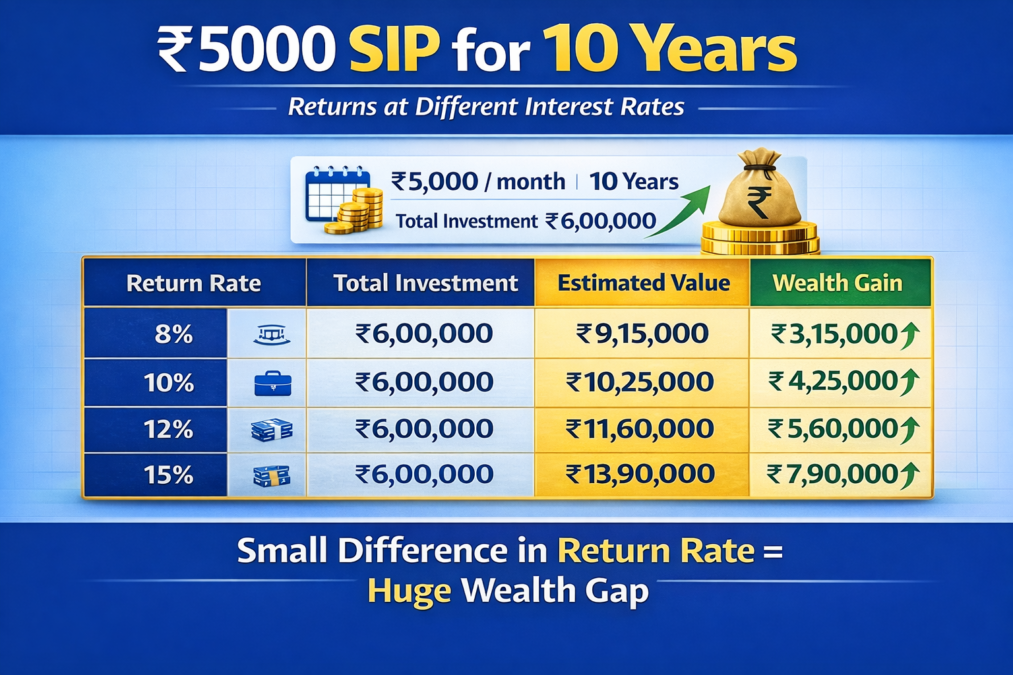
SIP (Systematic Investment Plan) returns are depend upon selected mutual fund and market conditions. Here we can see return on different rates.
If SIP give 8 % return
Suppose You start SIP for 10 years and the mutual fund that you slected for ₹5000 SIP give 8% return annualy then you will abole to make aprox 9.15 lakh with gain of 3.15 lakh.
If SIP give 10 % return
If your selceted mutual fund, for SIP give 10% return then you will able to make 10.25lakh with gain of 4.25 lakh.
If SIP give 12% return
let’s be optimistic, If your SIP give return of 12% annualy then you can make around 11.6 lakh in 10 years.
If SIP give 15% return
If market perform well the you may expect aprox 15% then you make 13.9 lakh on investment of ₹5000 monthly for 10 years.
Also read –How Much Will I Make, If I Invest ₹ 3000 SIP For 10 Years?
How ₹ 5000 SIP for 10 Years Create Wealth
The power behind SIP is compounding, where your returns start generating their own returns over the time. Here is Formula for SIP calculation.
FV=P×(1+r)n−1r×(1+r)FV=P×r(1+r)n−1×(1+r)
Where:
- P = ₹2000 (monthly investment)
- r = 12% (monthly return assuming 12% annually)
- n = 120 months
This formula shows how even a fixed monthly amount can grow significantly over time by power of Compounding.
Also read-Looking for Best SIP Plans For 1000 Per Month? Must Know This Before You Start
Which Mutual Funds Are Best for ₹ 5000 SIP?
If you are planning to Start SIP of ₹ 5000, You can choose the mutual fund according to your risk bearing capacity. You can Choose the given fund type below
- Large-cap funds – Laget Cap Mutual fund is consider stable for investment and can give you 12% to 15% return over long term.
- Index funds- It is very low cost mutual fund and it easiy to track is it made same line index. For example Nify50, Sensex etc
- Flexi-cap funds- Flexi cap Fund are more volatile and it has high risk to invest but it may give you more then 15% return in some cases.
You can Check mutual fund performance on AMFI official website.
Pro Tips For SIP
- Do not track your SIP investment Frequently.
- Invest for long term
- Do not expect unrealistic return.
- Slect good Fund not high return mutual fund.
- In market Crash do not stop SIP
- If Possilbe increase SIP amount by Step Up.
Also read -If I Invest ₹ 2000 SIP for 20 Years, How Much Can I Really Make?
Conclusion
Starting SIP of ₹ 5000 is good step for saving and to reach some financial goal. If you invest for 10 years, you may earn 13.9 lakh on 15% return. But before investing, select good fund or ask your financial advisor. Do not listen market noise.
FAQs
Can I withdraw SIP before 10 years?
Yes, but early withdrawal may reduce your overall returns and may attract exit load or taxes.
Should I increase SIP every year?
Yes, increasing SIP annually (step-up SIP) can significantly boost your final corpus.
How much can ₹5000 SIP grow in 10 years?
At an average return of 10–12%, a ₹5000 monthly SIP for 10 years can grow to approximately ₹10–11.5 lakh, depending on market performance.

Navnit Kumar (ARN-183463) is an AMFI-Registered MFD and financial expert with 8+ years of experience. Author of the Amazon bestsellers Anybody Can Trade and Anybody Can Trade Options , Navnit simplifies complex strategies like SWP & SIP to help investors achieve sustainable financial freedom.